Sunday, November 9, 2014

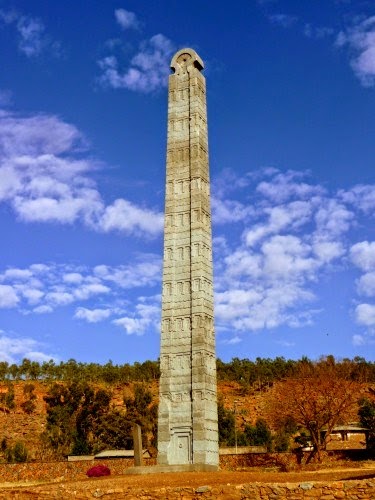
Aksum's Stelae


An observation by the Britsh Archaeologist Theodore Bent after a visit to Aksum in 1893.

Egypt's pyramids were like great advertboards announcing to the world the authority, power and prominence of the ruling families. And probably the Aksum's astounding stelae had the same purpose.

From among the many that you see in Aksum, particularly six of the stelae were carved in the likeness of the multistoried buildings complete with windows, doors and sometimes door handles and locks. The design and carvings follow the traditional Aksumite Architectural style.

In 1996 a broken plate that perfectly matched the rivet holes at the top of the stelae were excavated, strengthening the idea that in the former times ,metal plates, perhaps in the form of a crescent moon and disc, are thought to have been engrossed to the top of the stelae both at the front and back. The excavated plates bore the effigy of a face perhaps that of the ruler to whom the stele was dedicated.

At the base of the stelae you would find a stone platform. The platform is believed to have served as an altar where sacrificial offerings were held.

Among the mystery about these stelae are; why were they designed in this way? How were they transported (because, from among them, some weigh about 500 tones)? How were they erected? Archaeologists believe that the earthly forces of elephants, rollers and winches were probably applied.

The Northern stelae Park

The Northern stelae Park is situated in the North Eastern part of the town. It is the most important stelae field in Aksum because it contains over 120 stelae which range between 1 meter and 30 meters in height.

The great stele, which is believed to be the largest one block of stone that humans have ever attempted to erect, measures 33 meters. It has now fallen down probably in the process of resection or as a result of war.

King Ezana’s stele (24 meter in height) is now the tallest still standing. The British traveler by the name Henry Salt who visited it 1805 says “the most admirable and perfect monument of its kind.”

Among the various other stelae, the one that measure 9 meters and lies on the ground 200m to the North of King ezana’s stele, has got a unique decoration. Near the top of the stele a small house like object is carved in relief, formed by a rectangle surmounted by a triangle and this is claimed by some to be proof of Aksum’s claim to house the original Ark of the Covenant

The Looted Obelisk

The second-largest Stele, 25 m high, was shipped to Italy in 1937 during the Ethio-Italy war on the personal orders of Mussolini and taken to Rome to stand in front of the Ministry for Italian Africa (later the headquarters of the United Nations's Food and Agriculture Organization). In a 1947 UN agreement, Italy agreed to return the obelisk.

After years of pressure, the Italian government agreed, in April 1997 to return it; the first steps in dismantling the obelisk and shipping it home were taken in November 2003, with the intent to ship the obelisk back to Ethiopia in March 2004.

However, the repatriation project encountered a series of obstacles: the runway at Axum airport was considered too short for a cargo plane carrying even one of the thirds into which the obelisk had been cut; the roads and bridges between Addis Ababa and Axum were thought to be not up to the task of road transport; and access through the nearby Eritrean port of Massawa – which was how the obelisk originally left Africa – was impossible due to the strained state of relations between Eritrea and Ethiopia.

The runway at Axum airport was then upgraded especially to facilitate the return of the obelisk, the heaviest object to ever be transported by air. The dismantled obelisk remained sitting in a warehouse near Rome's Leonardo Da Vinci International Airport, until Tuesday, 19 April 2005 when the middle piece was repatriated by use of Antonov An-124, amidst much local celebration. The second piece was returned on Friday, 22 April 2005, with the final piece returned on Monday, 25 April 2005. As of January 10, 2006 [1], the obelisk is in storage as Ethiopia decides how to reconstruct it without disturbing other ancient treasures still in the area.

A Recent Further Archaeological Discoveries in Aksum

Major archaeological vestiges have been discovered at the World Heritage site of Aksum (Ethiopia) by the experts UNESCO sent to Aksum (Ethiopia) to survey the World Heritage Site in April, 2005. They were sent to prepare for the elevation of the Aksum Obelisk at its original location.

Underground chambers and arcades have been found in the vicinity of the original location of the obelisk. Geo-radar and electrotomographic prospection – the most advanced technologies for underground observation – revealed the existence of several vast funerary chambers under the site’s parking ground.

According to the experts, the site is a royal necropolis used by several dynasties before the Christian era. It stretches considerably beyond the perimeter of the present archaeological site, at the foot of Mount Saint George and Mount Mariam.

Friday, October 17, 2014

Giant mosaic floor uncovered in mysterious Alexander the Great-era tomb in Amphipolis, Greece


The mosaic depicts Hermes, the messenger of the gods in front of a horse drawn chariot.

An imposing mosaic of a man driving a chariot has been uncovered in the largest antique tomb ever found in Greece.

Archaeologists unearthed the tomb dating to the time of Alexander the Great in August at Amphipolis in northern Macedonia.

The mosaic dates from the 4th century BC.

Tiny pieces of white, black, blue, red, yellow and grey create a picture of a chariot drawn by two white horses, driven by a bearded man wearing a crown of laurel leaves.

Hermes, the messenger of the gods in ancient Greece, stands in front of the chariot.

"This mosaic, the largest on the site, measures 4.5 metres by three metres and is not completely uncovered," the Greek culture ministry said in a statement.

Archaeologists think the magnificence of the tomb means it was built for someone very important.
There is widespread speculation over who was buried at the site: from Roxana, Alexander's Persian wife, to Olympias, the king's mother, to one of his generals.

"The tomb is definitely dated to the period following the death of Alexander the Great [in 323BC], but we cannot say who it belonged to," supervising archaeologist Katerina Peristeri said.

Built on the banks of the river Strymon, 60 kilometres from the modern city of Serres, Amphipolis was an important city of the ancient Macedonian kingdom under Alexander.

Roxana and her son Alexander were exiled to Amphipolis and murdered there on the orders of the Macedonian king Cassander around 310BC.

There were no suggestions the tomb could have belonged to Alexander himself, who died in Babylon, in present-day Iraq.

LINK

Monday, October 6, 2014

Anglo-Saxon Farm and Field


Diagram illustrating the resources exploited at the early Anglo-Saxon settlement at Bishopstone, Sussex. The evidence from the buildings and the cemetery is shown in the centre, surrounded by the resources derived from the sea-shore, arable fields, pasture and the Weald (data: Bell 1977)

An Anglo-Saxon farmstead could draw on a variety of environments to maintain the supply of essential resources. The evidence recovered from excavations emphasises that the landscape was being fully utilised by the inhabitants of farms, or groups of farms, dispersed across the landscape. 

The extent of utilisation is exemplified by the settlement and cemetery excavated on a hilltop overlooking the English Channel at Bishopstone, Sussex, (Bell 1977). In the fifth century buildings were erected over an earlier farm and fields. In the pastures stood sheep, cattle and a few horses and roaming more freely were geese, fowl and cats. Growing in the arable fields during the summer months would have been a crop of barley amongst which various weeds were growing, including fat-hen, common orache and black bindweed. The food produced in this way was supplemented by marine resources: mussels, limpets and periwinkles gathered on the foreshore, conger eel from the lower shore and whiting taken from the sea; nets were made on the farm. The animals not only provided dairy products, meat, leather and wool for clothing; bone was used to make such things as combs, weaving tools and netting needles. In nearby woodland pigs were reared, and red and roe deer were hunted. Also taken from the woodland were oak, hawthorn and hornbeam used for building, for fuel and for the wooden implements found in the adjacent cemetery. Clay and ironstone were brought from the Weald to manufacture pottery, spindle-whorls, loomweights and a variety of iron implements including nails, knives, spears and shield fittings. Copperalloy and silver items were manufactured or acquired and eventually buried, along with considerable quantities of other material, as gravegoods in the community's cemetery. 

This picture of subsistence agriculture varies little between settlements and any minor variations may be seen as the result of local environmental, social or cultural differences, survival or the recovery technique used in excavation. Some of the differences are most marked; for instance at Cowdery's Down, Hampshire, the large proportion of cattle bones is the result of the discovery of a complete cow on a site where generally few animal bones were found. There is generally little variation in the quantities of bones of each species found on settlements; at West Stow, Suffolk, the proportions of animal species and the particular bones were the same in all types of context.

The settlement of West Stow was located on the banks of the River Lark in the relatively dry Breckland region of East Anglia. This is reflected in the animal bone recovered (West 1985; Crabtree 1985, 1989a, 1989b). The environment was quite different from that at Bishopstone: the valley provided good pasture, while the river itself was home to fish and water fowl; the river terraces supplied good farmland; and away from the river terraces the higher slopes provided rough grazing. Analysis suggested that hunting of deer and other wild mammals and of birds was rare and that at all stages in the settlement's history cattle, sheep and goat, pig, horse, geese and chickens provided the majority of the meat diet; cats and dogs were present but apparently were not eaten. Typically the commonest domesticated animal was the sheep or goat, which was increasing in importance throughout the period in preference to cattle, unlike Continental settlements where sheep are less common. The sheep at West Stow were being used mainly for a combination of meat production and dairying, with a small amount of wool being used for domestic purposes (West 1985:93). Cattle at this time were generally goodsized, perhaps the result of the provision of reasonable grazing and implying successful husbandry. Horseflesh was more commonly eaten in earlier periods and on contemporary settlements on the Continent than at West Stow. The third most common animal found at West Stow was the pig which was being consumed in large numbers during the early fifth century. 

This is surprising when the Brecklands are more suitable for sheep-rearing. Pigs were comparatively rare on the Continent at this time. Crabtree suggests (1989a: 210) that this may be because of the time it would have taken settlers to establish their herds of sheep and cattle; pigs on the other hand `mature quickly and multiply rapidly' and would be very suitable for such circumstances. This assumes, however, that the shape of the system of animal husbandry was driven by the needs of migrants. However, the differences between meat consumption and kill-patterns in England and on the Continent suggest different cultural influences. In contrast there was no change in butchery techniques and killpatterns between early Anglo-Saxon West Stow and in local Romano-British samples and there is no evidence for the introduction of new breeds in the fifth century. The evidence indicates that native traditions of animal husbandry were a greater influence than any Continental traditions that might have been introduced with the migrations. 

At West Stow wild animals were not commonly hunted, their remains making up less than 1 per cent of the total. As a representation of the make-up of the diet this would seem to be typical although the quantity of wild animal bones does not necessarily convey their social importance. At West Stow these comprised red deer, roe deer, badger, hare, fox, beaver and the European brown bear as well as large water birds including teal, white-fronted goose, swan and crane. At Walton (Buckinghamshire) beavers, cranes, plover and redwing were identified (Farley 1976) but were equally rare. The infrequency with which wild animals were taken may be reflected in the similar rarity of the bow and arrow (Manley 1985). One bow was described by the excavator as about five feet in length' (Hillier 1856:30). In a Warwickshire cemetery, Bidford-on-Avon, were `several arrowheads of different patterns with closed sockets' (Humphreys et al. 1923:96- 7). The bow and arrow may be used as a weapon as well as for hunting game but it may be significant that not only are they rare in early Anglo-Saxon contexts but so also are other tools. The burial of weapons in graves appears to have been controlled by a particular set of rules and it may be significant that the bow and arrow is not included in that context. The rarity of the bow may also indicate that some hunting was restricted to particular social groups. 

Animal husbandry in the early Anglo-Saxon period appears to have been designed to satisfy immediate local needs, but evidence that the situation was changing towards the end of the period can be found by comparing such food resources with those at the earliest post-Roman urban and commercial centres in England; Hamwic, the middle-Saxon port of Southampton, and Ipswich (Suffolk) have both seen large-scale excavation and have produced useful assemblages of animal bone. Middle-Saxon rural settlements, like those earlier, were supplied with domestic animals as well as some wild ones, whereas the latter are rare at Hamwic (Bourdillon 1979; Crabtree 1989b). 

Although they were eventually eaten, the Hamwic sheep were not reared primarily for that purpose, and there are lower proportions of fowl and poultry than at early and middle- Saxon farms. The numbers of cattle on both rural and urban middle-Saxon settlements are very similar but their size is larger than their earlier counterparts suggesting some improvement, whereas there was no significant development in the size of pigs. The conclusion would seem to be that the early Anglo-Saxon countryside was managed differently, or not as efficiently, as in the following centuries. In the eighth and ninth centuries the killing age of domestic animals was earlier in rural contexts, whereas at Hamwic the bones do not reveal such early mortality, implying that the town, divorced from the wild, was not affected by the immediate hazards of the land or that it was supplied with animals of selected older age groups (Crabtree 1989b: 207). The early killing age at the early Anglo-Saxon settlement at Walton need not reflect success in animal husbandry.

Wednesday, July 16, 2014

The temple on the Ness of Brodgar


Lead by archaeologist Nick Card, a team opened eight exploratory trenches in the first season. It was soon confirmed the unremarkable rounded ridge was entirely artificial and finds near the surface indicated the structures could tentatively be dated to the late Neolithic period, or around 2300 BC. Neolithic buildings of this shape and size were unknown prior to this and what had been an inconsequential hillock on a little spit of land had become the United Kingdom's historical discovery of the decade! 

Since then, excavations at the Ness of Brodgar have occurred each summer season and it's been described by many who have worked here as the archaeologist's dream site. Its clean walls, copious finds and limited later construction on the hill's surface means the remains are providing more information about this period than any other excavation has before. Only around 10-15% of the site has been cleared thus far and already it's overwhelmed even the most cynical historian. 

For the first four years, speculation continued to rage about its purpose. Nothing had been found like this in Britain and internationally, the only relatable sites were two in Malta. Although the Ness site was originally ventured to be a settlement, what ancient settlement required outer walls to be more than two metres thick? No one had ever seen rectangular Neolithic houses with multiple, erraticallysized entrances. The evidence didn't fit with a settlement. So, perhaps it was a temple? However, Neolithic-period temples are so rare in Europe, this loaded term would only be committed to with indisputable evidence. This mystery was enticing and aroused the imagination of everyone who laid eyes on the excavation. 

Piece by piece, season by season, the earth was scraped back. Constructed of skilfully stacked flat slate pieces, individual buildings rose between pathways, odd hearths appeared in doorways, the strange and enormous enclosure wall seemed to force passage through the precinct and hundreds of artefacts emerged, all dating to before the Bronze Age. Patterned and even painted stones were uncovered, testifying in its heyday, the structures would have been colourful and eye-catching. The finds included both whale ivory and stone mace heads (symbols of status), a small fired-clay figure now called `The Brodgar Boy', slabs of rock engraved with geometric patterns and an ingeniously carved stone ball. 

Most importantly, there was a telling lack of domestic flints, pottery and household waste which usually accompanied settlement. There was no other explanation, it had to be ceremonial.
Archaeologists can now conclude that on the Ness of Brodgar is one of the rarest of rare Neolithic temple complexes. And, just as amazing, is that while the Salisbury Plain henges and ceremonial pathways bear a striking resemblance to these monuments, they are several centuries younger. The discovery of the Ness complex, its purpose and significance had literally turned British prehistory on its head. Evidence suggests the temple had functioned for a thousand years. It had endured multiple rebuilds by the local farming communities who dedicated their sacred space to the seasons and landscape from which the were entirely governed. They worshipped pagan gods and ancestors by performing cleansing and passage ceremonies and most likely progressed from building to building as part of this ritual, leaving hundreds of sacred objects behind for their deities. 

Then, approximately 600 years after the complex was first built, the massive Ring of Brodgar was constructed to the north and the temple's internal buildings were replaced with a single, large structure (25 x 25 metres/82 x 82 feet). Archaeologists have conjectured that for the next three centuries, the single building and Ring to the north became the final destination on a sacred pilgrimage from life to death. 

Finally, the Ness of Brodgar temple, already ancient by its own standards, went out of use in around 2300 BC. Evidence points to the locals heralding the end of the temple's era with a momentous party that could have lasted days and hosted masses of people. This is known because just beside the enclosure wall was a pile of bones of approximately six-hundred cattle, all carbon dated to the same time of approximately 2300 BC. Six-hundred cattle can feed ten-thousand people and cut and burn marks indicate they feasted well. 

After the cattle slaughter, no further evidence remains to support further use and either by the natural progression of time, or even by the partiers themselves, the walls were pulled down and the foundations buried. A new era of technology had begun - the Bronze Age - forever changing religious practices and beliefs and the old temple was sent extravagantly back into the earth where it lay in secret for 4000 years until a geophysicist and his modern machine stumbled across it. 

The temple on the Ness of Brodgar remains the most evocative of ancient sites discovered in Britain. Eight-five percent of this site still remains within the earth and many expect this once commonplace hill to surprise for many years to come.

LINK

LINK